Black Women at the Met Gala 2026
- Casey Russell
- May 5
- 6 min read
Fashion Is Art — And This Was Authority
The Met Gala 2026, held May 4 at the Metropolitan Museum of Art in New York City, centered on the theme “Costume Art.”
And looking at these looks, the theme wasn’t just interpreted. It was understood.
This wasn’t about attendance. It wasn’t about trends. It was about control, intention, and narrative.
What the Carpet Said
Across these images, there is consistency: strong silhouettes, intentional volume, a studied balance between softness and structure. These looks feel like decisions.
Some leaned into softness — volume, draping, movement. Others leaned into structure — sculpted, architectural, controlled. But all of them understood restraint. When the theme became real, the difference showed.
Some approached the night as fashion. Others approached it as concept. The strongest looks weren’t outfits. They were ideas.
“Softness, fantasy, minimalism, and structure all coexisted — but with clarity of purpose.”
Casey Russell
Risk was present — but intentional. Not shock value. Not confusion. Controlled experimentation.
THE LOOKS
DOECHII

Draped in deep burgundy chiffon with a towering sculptural turban headpiece, Doechii arrived as something between deity and declaration. The fabric cascaded and trailed, held with controlled looseness — a look that felt simultaneously ancient and entirely now. The emerald drop earrings were the one flash of contrast. Everything else was singular and committed.
YSEULT


A black structured gown with an oversized architectural silhouette and a golden body-cast torso panel at the center — Yseult’s look was conceptual fashion at its most direct. The hat, wide-brimmed and sweeping low over her face, created a frame rather than an accessory. This was a costume in the true sense of the theme: a built idea worn on a body.
A’JA WILSON

The WNBA star arrived in a full-length bronze metallic gown with a dramatic matching cape that spread across the carpet. She wore the look with the composure of someone who understands that presence is the detail. The stacked gold choker necklace and the platinum-blonde finger-wave styling landed the whole picture.
MISTY COPELAND

A brown tulle ballgown — cropped at the bodice, billowing below — and Misty Copeland did what she’s always done: she moved in it. Arms extended, skirt fanning, she made the carpet a stage. The look was deceptively simple. The execution was the statement.
JANELLE MONÁE


A gown built from layered cables, circuit boards, green moss, and mechanical components — with monarch butterflies and dragonflies woven throughout. Monáe’s look was the most literal interpretation of the “Costume Art” theme: it was a wearable sculpture. Technology overgrown by nature. The future composting into something alive.
TESSA THOMPSON

Electric blue, strapless, with swirling cutout panels at the bodice and a sweeping train that ended in scalloped edges — Thompson’s look had a graphic quality that read almost like a painting. Bold without being loud. Sculptural without being stiff.
ANGEL REESE

A blush pink off-the-shoulder gown with voluminous ruched fabric and a high slit — Angel Reese wore romance as armor. The hair swept up, the diamond necklace understated against all that pink volume. The look was deliberately feminine and deliberately grand.
NIA LONG


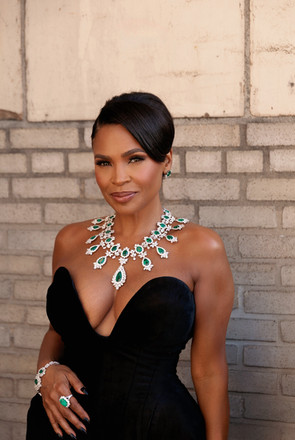
A strapless black velvet gown with a sweeping train, anchored by one of the night’s most remarkable jewelry moments: a diamond and emerald statement necklace draped asymmetrically across one shoulder. Nia Long has always known that classic doesn’t mean safe. This proved it again.
CHASE INFINITI

A sequined column gown in a swirling abstract pattern — reds, yellows, blues, greens — with a fringe train in matching rainbow hues. Chase Infiniti wore color as language. The look had the feel of a mural translated into fabric. Loud, joyful, and entirely intentional.
ADUT AKECH


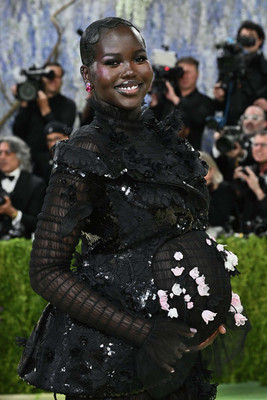
Pregnant and fully present, Adut Akech wore a black lace and chiffon sculptural gown — sheer, appliqued with delicate 3D florals blooming across her belly. The combination of gothic structure and soft pink flowers created a visual tension that was the most quietly radical look of the night. She wore motherhood as haute couture.
CIARA



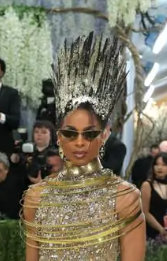
Gold from the neck to the floor — a crystalline, encrusted column gown with ringed metal harness detailing from collar to chest. The headpiece: a towering black sculptural crown. Ciara leaned fully into an Egyptian futurism. It was commanding in the way only a look with total commitment can be.
LALA

A rich chocolate brown strapless gown covered in intricate lace applique and teardrop crystal embellishments. The auburn hair was the finishing counterpoint — warm against the cool glitter of the crystals, and just enough contrast to keep the eye moving.
KEKE PALMER




A fire-red off-the-shoulder mini with a sweeping tulle train — and matching red pixie hair. Keke Palmer understood that the carpet is a stage. The look was theatrical, high-contrast, unapologetically pop. The diamond choker was the one cool element in an otherwise hot palette.
SZA

A full golden-yellow ballgown with a corseted bodice, painted butterfly wings as the skirt panels, and a headpiece of yellow orchids, wire, shells, and jewels. SZA arrived as a garden. The look absorbed the room. It was maximalism with a clear center — nature as ceremony, ceremony as fashion.
AYO EDEBIRI

White draped chiffon, one-shouldered, with a high slit and white feather detail at the strap. Simple. Clean. Ayo Edebiri wore the kind of restraint that only reads as confidence. The look didn’t compete. It stood apart.
TEYANA TAYLOR



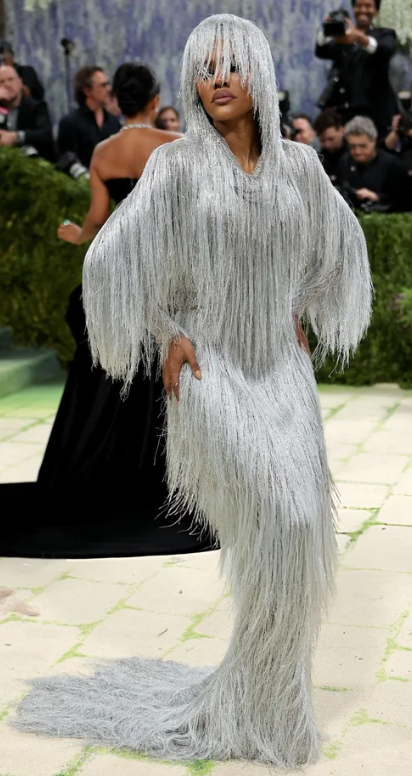
Head-to-toe silver fringe from neck to floor, a hooded silhouette that pulled over her face, leather gloves, a towering feathered top hat, a cane, and platform heels — Teyana Taylor didn't walk the carpet so much as activate it. Every step made it move. Every angle made it different. That was the point. The hood was the decision that made everything else land. It obscured just enough to create mystery without losing presence. The fringe did the rest — kinetic, architectural, alive. This wasn't a look you admired from a distance. It pulled you in and made you watch. As a member of the 2026 host committee, Taylor came with receipts. Not dressed for the occasion — dressed as the occasion. Silver has never felt this intentional.
ACCESS VS. UNDERSTANDING
The Lauren Sánchez Conversation

This is where the conversation gets interesting — and important to get right. Because the point was never negativity. It was clarity. The reference wasn't subtle. Mrs. Bezos' dress was a near replica of John Singer Sargent's famous painting Madame X - one of the most famous paintings in fashion history. The story behind the painting goes
"Sargent was so taken by Madame Gaudreau that he asked to paint her. She wasn't stunning by birth alone - she was interesting. She had an air about her. He worked hard at his craft, she brough her full self to the sitting, and together they created something that shocked Paris society. One shoulder strap down. A scandal. A masterpiece."
Seema R. - Artlust

Placed next to looks rooted in concept, structure, narrative, and artistic intention, Lauren Sánchez’s moment at the 2026 Met Gala highlighted something the theme made impossible to ignore: access to fashion is not the same as understanding fashion as art. At a Gala themed “Costume Art,” every look becomes a statement — even the ones that don’t intend to be. The assignment wasn’t to dress well. The assignment was to demonstrate a relationship with the idea. And that’s a different skill set entirely.
“This is not brilliance you bought. This is brilliance you earned .”
Seema R. - ArtLust
This isn’t about exclusion. It’s about alignment with the assignment. And when you stand the carpet’s most concept-driven looks alongside something that reads as wealth rather than vision, the gap becomes visible — not cruel, just clear.
The theme demanded intention. Intent can’t be purchased.
THE STANDARD
Beyoncé — Not the Competition. The Benchmark.

As co-chair, Beyoncé didn’t just attend the 2026 Met Gala. She set the tone for what the night was asking of everyone who walked through those doors.
The image she released said everything: a full-length gown in sheer ivory, cascading crystal embellishments tracing the body’s form, a feathered cape spreading behind her like wings at rest, and a spiked crystal crown. She looked like a relic from a religion that hasn’t been named yet.


But beyond the look itself — her presence as co-chair shifted the question the entire night was being measured against.
The 2026 Met Gala raised a record $42 million, but money was never the point of what happened on that carpet. The theme "Costume Art" created a test that couldn't be avoided — and the results were visible in real time. This wasn't about extravagance. It was about clarity. It wasn't about access. It was about intention. And it wasn't about decoration. It was about execution. Black women understood that assignment completely — not just participating, but defining how the theme was interpreted. From Janelle Monáe's wearable ecosystem to Adut Akech's gothic bloom, from Ciara's gilded command to Ayo Edebiri's studied restraint, these weren't outfits chosen for a red carpet. They were answers to a question the theme was asking. Which brings us to the only question worth closing on: did this feel like a celebration of fashion? Or did it feel like an Anna Wintour Met Gala? Because the energy was controlled, curated, and entirely intentional — less like a party, more like a presentation where everyone on that carpet was being measured, whether they knew it or not. Think Miranda Priestly in The Devil Wears Prada — not raising her voice, not making a scene, just watching while everyone in the room quietly adjusted, because the standard was that legible. That's the 2026 Met Gala. Not a celebration. A demonstration. A quiet, expensive, beautifully dressed reminder that real fashion — fashion as art — was never about what you can afford to wear. It's about whether you understand why.


Comments